Coimbra

This morning we took advantage of the yellow sight-seeing tour bus which conveniently stops just outside the main gate of the campsite and takes you straight down to the city.   


Hopped off just before the bridge to see the convent of Santa Clara a Velha (12th C).  Its location right on the edge of the river Mondego became its downfall as it suffered from flooding right from its conception.  The church was redesigned with an upper floor added as the ground floor was already under water.  The convent was abandoned in the 1600’s and a new convent was built further up the hill.  The site has now been excavated by building a 20metre deep river defence wall.


Across the bridge and up the main shopping street we visited another church and monastery this time Santa Cruz which holds the tombs of the first two kings of Portugal, Alfonso Henrique and Sancho 1.  The monks at the church were the first tutors at the University of Coimbra.  


The old cathedral (12th C) and new cathedral are also worth a visit - by the time we reached the university at the top of the hill we had visited 7 churches!


The tour around the old university is a must especially the Biblioteca Joanina.  An 18th Century extravaganza – gilded woodwork and exotic woods adorn this library which holds over 300,000 books.  The streets were full of students in their gowns some looking rather red faced after doing their dissertations, we know this as part of our tour gave us a glimpse of the halls they were using!  


The city had a lovely lively feel to it and with so much to see there it was with very weary legs that we finally stepped back onto the yellow bus for our return to the campsite.

Batalha Monastery

Another day another church, this time Batalha with its Gothic architecture this is the opposite to the austere Alcobaca. 
  

The entrance and cloisters are very ornate. 


In the Founder’s chapel there is the joint tomb (the first one in Portugal) of Joao I and his English wife Phillipa of Lancaster, and also the tomb of Henry the Navigator. 


 The Manueline portals of the unfinished chapels were a highlight. 


 The afternoon drive took us further north to the university city of Coimbra to stay at the municipal  campsite on the hill outside of town.

Alcobaca and Fatima

Leaving our 6E in an honesty box for our overnight stop we travelled north to Alcobaca, Portugal’s largest church.  The church and its Cistercian monastery have been greatly added to over the centuries.   


This church is renowned for its medieval architecture the central nave and lateral aisles both 20m in height coupled with its length of over 100m gives the impression of grandeur. 


 The tombs of Pedro I and his ill fated love Ines de Castro sit facing each other across the central aisle.  


The 18th century fully tiled kitchen with its huge chimney above a spit big enough to roast a whole ox was an amazing site. 


As we were close to Fatima we decided to visit the Shrine and take advantage of the free camping aire in the car park.  The weather had closed in but we still managed to see the great square which is twice as large as St Peter’s in the Vatican.  It was quite busy with pilgrims despite the rain.


Obidos

Just a short journey back inland to the 14th Century walled town of Obidos (pronounced Obish!).  We parked the van at a privately run camperstop just on the outskirts of town near the viaduct, and entered the town on foot through the Porta da Vila.   

Porta da Vila

The chocolate festival finished the day before, but the town was still in party spirit, with plenty of chocolates still available (yum, yum).  The weather was glorious, and the views from the fortified walls were spectacular. 


The castle is now a Pousada (expensive hotel).  The whole town was extremely well kept and very picturesque. 


 After enjoying a cup of coffee on the Rua Direita we picked up some traditionally made pastries for our tea and returned to the camperstop for the night .

Peniche and journey

We started early again today and were away from the camp at 7.00am. Off to see the standing stones in the next village. They are two Menhirs or standing stones probably from around the fifth or sixth millennia BC. The largest of them is 5.6 meters high and quite impressive.


On across country through some lovely scenery marred by some bad weather on route. We arrived at Peniche on the Atlantic coast by 1.30pm and set up camp right on the cliff tops overlooking a very angry ocean.  Sarah decided we were to walk to the harbour which proved to be further than the book said. The coast line is  amazing with slabs of what was once a limestone pavement , broken and scattered in unbelievable shapes. The harbour was very nice and we cut back through the centre of town saving a hours walk.


Mourao and Monsaraz

We continue our journey north with a visit first to Mourao notable for its pepperpot chimneys and its 14th century Castle, overlooking the new Alqueva dam and Barragem. The castle is in very good condition and they are trying to stabilise it as best as possible. The walls are walk able and it has eleven square towers in various stages of  repair. A very interesting morning.


Continuing on we came to our overnight stop at the camping aire at the Castle of Monsaraz.
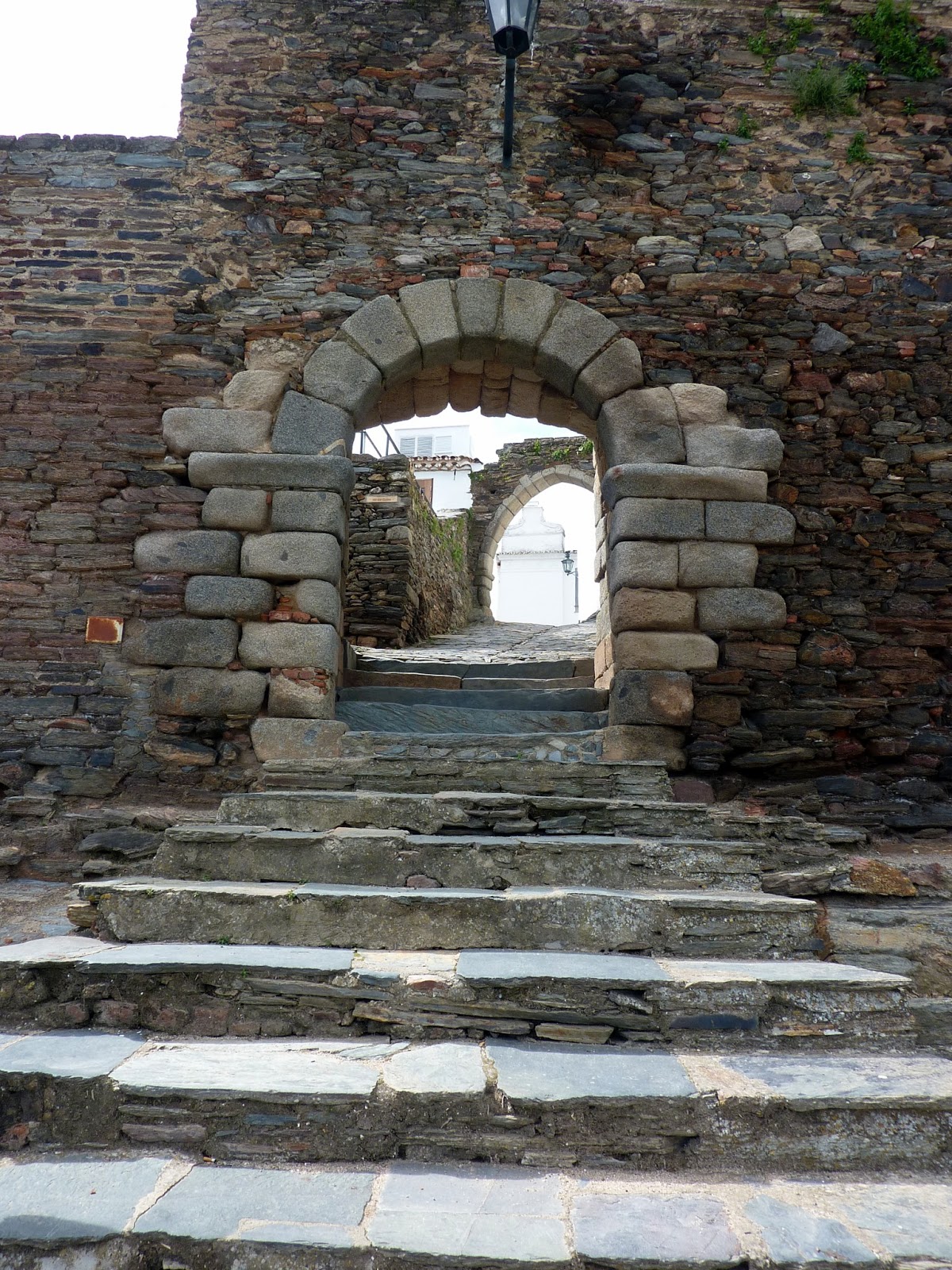
A very steep ascent up a cobbled road lead us to the foot of the walls to the town and our camp site for the night. The views over the Barragem and the Valley of the Guadiana were breathtaking, a more beautiful spot to stay the night would be difficult and FREE.!!! as well. We took a walk around the town and of course the Castle. Thirteenth century again and with a bull ring amphitheatre as well. The town is all within the surrounding wall which is very complete with gateways around the perimeter.


Serpa

Serpa is our next stop and is a Moorish town with an Aqueduct and castle rebuilt in the late 13th century. It is a very pleasant town with pretty whitewashed houses and well worth a visit.