Campo Geres walk

The sun is shining and we have ants in the van!  After 2 hours of extermination we were ready to get out for a walk.  The young lady on reception spoke good English and was extremely helpful showing us which way to go.  The trail took us up a beautiful valley and then down the otherside to the Vilarinho das Furnas reservoir.


  Near the lake the trail joined the Roman road which runs from Braga to Astorga in Spain.  The Roman road has some fantastic engraved milestones and the original surface is still visible in places.


At this point we saw two girls coming down the hillside, one of which turned out to be our receptionist, she obviously has heard about Rob’s navigational skills.  The return leg took us through the old village of Campo do Geres were we met a delightful villager with a basket of camellias balanced on her head.  She kindly agreed to a photograph. 


 At this point in the journey taken the map off him, I failed to mention a short cut home and made Rob walk another 3 miles for his health - OOPHS


Peneda

Continuing our whistle stop tour we headed for the shrine of Nossa Senora da Peneda.  This is a replica version of Bom Jesus but the setting is much more dramatic and the actual sanctuary is in excellent condition with much restoration work already completed and still some being carried out on the surrounding buildings.  Everywhere looked cared for and fresh.    


The waterfall that tumbles down the mountain just to the left of the shrine was in full flow and formed a perfect backdrop.


Unfortunately for Rob the sun came out at precisely the wrong moment which meant my secretly planned ascent of the mountain behind could take place.  A well laid out path rose steeply from the back of the sanctuary, and zig-zagged all the way up to the top and its mountain lake.  There were terrific views of the waterfalls on route and even Rob enjoyed himself!  


 We continued our journey through the Park and saw some stunning landscapes, pretty villages with their espigueiros (raised granite grain stores) which are typical of this area. 


Our route took us through the border to Spain and half an hour later back again, then down the valley along some very narrow roads often cobbled, to the spa town of Geres and then up the other side of the lake to Camp do Geres and our campsite Campismo De Cerdeira.


Castro Laboreiro


The local bus system n the Peneda Geres National Park is non-existent so as the weather showed a slight improvement, we took the van out for the day to the traditional village of Castro Laboreiro.  The village is famous for the local breed of sheepdog of the same name.  We took the trail out of the village and up to the 13th C castle ruins.  Later we found out that we had walked up to the castle by the old supply route and down by the soldiers route.  


We were blessed with a break in the clouds and were able to get some great views out the surrounding mountains and spectacular waterfalls. 


There was a different route down which led us directly into the old centre and we arrived at the museum just before lunch.  The curator gave us a good insight into how the local people live and work and there was an original dwelling next door to the museum furnished with traditional items.


A lot of the villages within the park are seasonal – the higher altitude abodes for the majority of the year but the lower dwellings are used from December to Easter.


Peneda Geres, Lamas de Mouro

From Viana Do Castelo we headed up into the National Park of Peneda Geres.  This park is spectacular.  Hardly any traffic on the narrow roads so we were able to make a slow scenic journey from the coast along the Minho river and then up into the mountains to the northern entrance of the park at Lamas de Mouro. 


 Phillipa and Ludi made us very welcome at the campsite.   According to Phillipa there is a pack of wolves living behind the campsite in the mountains.


The sun decided to shine on us so we took advantage of that and went for a walk from the information centre .  The area is very unspoilt and due to the heavy rain streams sprung from every crevice.  At one point the path became a stream and a divert through a field was necessary.


The villages here are very traditional and they still follow the old customs of farming and living.  The communal wood burning stove was in the centre of the village.


Viana do Castelo

We arrived at the Inatel campsite at Viana do Castelo on the 31st, and the sun came out to greet us.  We sat outside in our deck chairs for the first time in weeks.  The following day we walked over the Eiffel Bridge into the old town centre.


  The Praca da Republica is surrounded by some wonderfully restored 16th Century buildings .  The first being the old town hall and to the left of that the Misericordia.  In the centre of the square is the old fountain which was originally the main drinking water supply. 


 The whole town is overshadowed by Saint Lucia Basilica high on the hill side.


Bom Jesus do Monte

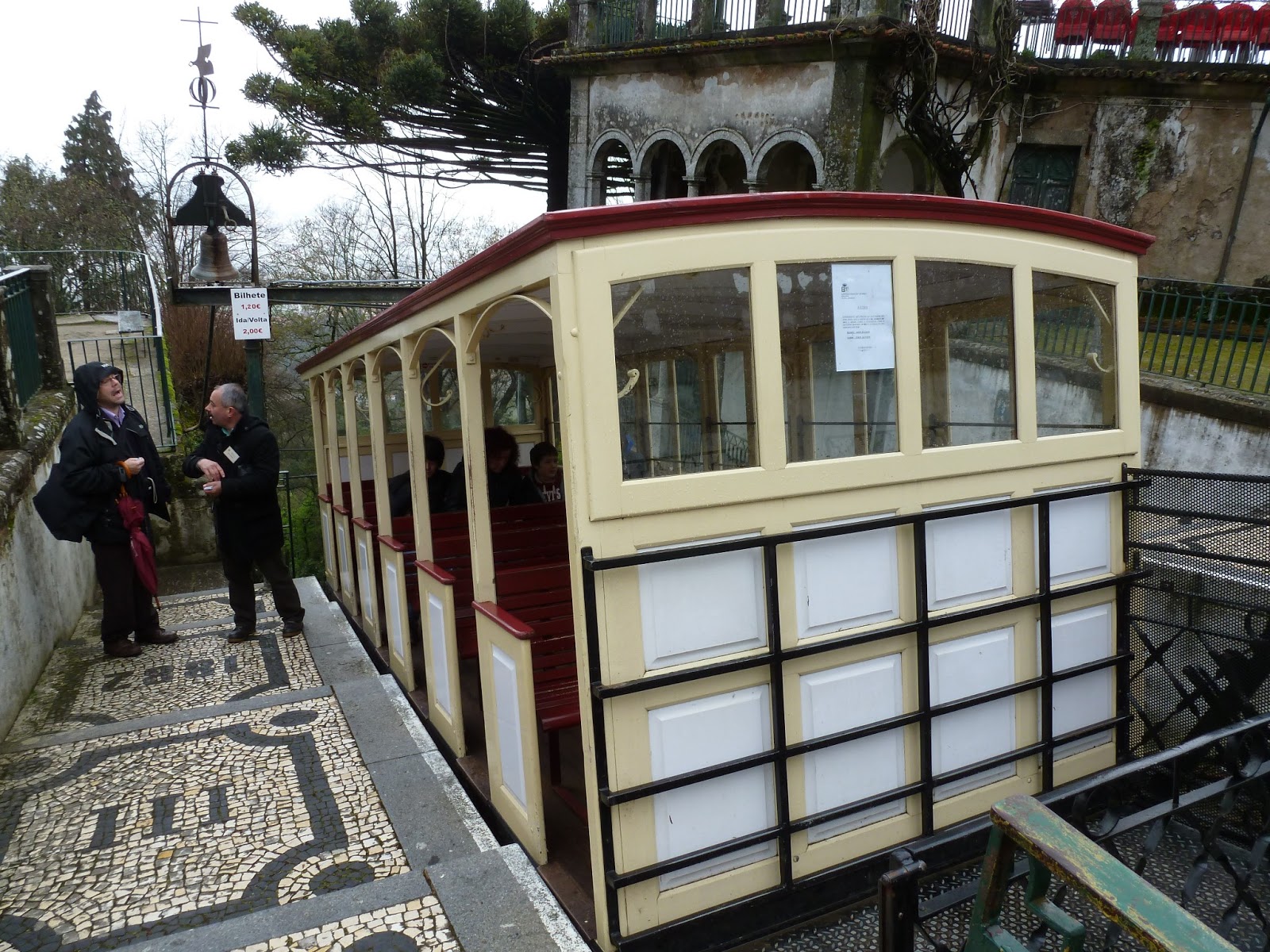
Bom Jesus do Monte is Portugal’s premier religious sanctuary.  Located on a hillside just out Braga the sanctuary stands at the top of a granite staircase, which represents a spiritual journey.  The lower section winds up from the car park with chapels showing the 14 stations of the cross.  The place reflected a certain aura of faded glory. 


 For those who cannot manage the stairs there is a hydraulically operated funicular (dating from 1822) which we took on the way down.


Braga

It’s still raining! Our journey to Braga was uneventful and the municipal campsite 20mins from the town is friendly although very soggy.  The town of Braga is the old ecclesiastical centre of Portugal.  The cathedral’s 15th C facade was decked out for Easter and the gilded organs were very impressive. ( sorry no picture of the inside as no photographs were allowed).   


The centre has some lovely buildings one being the 14th C ruins of the Archbishop’s fronted by the lovely garden of Santa Barbara.  


The old shopping streets were well preserved the Cafe Braziliera furnished in 19th century salon style was a great place to watch the world go by. 


As you can imagine there are many churches, our favourite being the 16th C Capela dos Coimbras.    


There are many grand houses in Braga, but the prize for the most colourful goes to Palacio do Raio.

The old centre has a very relaxed feel to it and the main square was filled with an Easter Fair with plenty of stalls tempting you with local products.